Subscribe to our Newsletter
Get regular stories, tips and solutions from Sustainable America and opt-in to receive roundups of the latest food and fuel news.



May 10th, 2012 | By Nicole Rogers
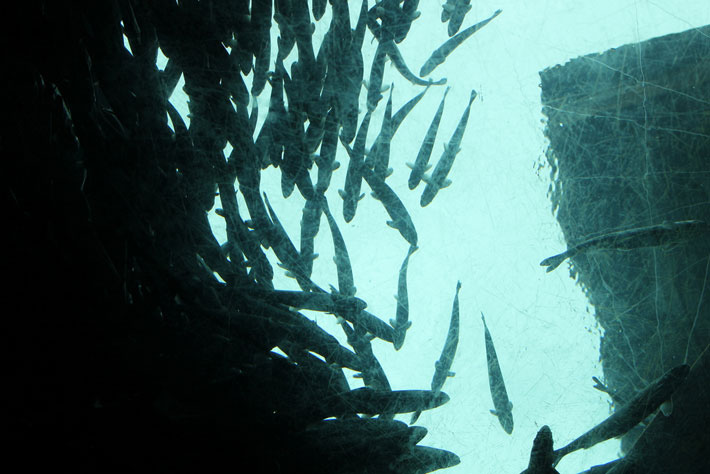
Global consumption of fish has doubled since the 1970s. In the US we’ve witnessed a boom in the popularity of sushi restaurants, the Mediterranean Diet is all the rage, and the benefits of omega-3 fatty acids are hailed on every talk show. It’s no wonder more Americans are seeking fish is an important part of a healthy, well-rounded, not to mention delicious diet.
As healthy as fish can be for our bodies, fishing can be a real problem for our oceans. Overfishing and other unsustainable fishing practices are the greatest current threat to our oceans, according to Ocean Wise. Aside from direct damage to the ocean, the carbon footprint of fishing can be huge. “Over 95% of the seafood consumed by the community of Santa Barbara, including UCSB, is imported. Additionally, at least 95% of the seafood caught locally is exported,” reports the Associated Students Coastal Fund. And Santa Barbara is a coastal area with fisheries nearby! Imagine the energy expenditure, not to mention the cost, of such a process.

Enter the Santa Barbara Sustainable Seafood Program. Run by the Santa Barbara Museum of Natural History, their mission is to help the public make more informed decisions about the seafood we eat. Local restaurants and markets gain free membership to the program by taking a pledge to take steps to avoid unsustainable seafood. In return, the program helps members make the switch to sustainable seafood, and promotes member businesses by letting the community know that they provide consumers with an alternative to unsustainable seafood. Each restaurant and market gets a certificate and a sticker for their window to signify their participation in the program. In addition the Sustainable Seafood Program promotes participating businesses through exhibits, banquets and festivals held at the Ty Warner Sea Center.
An exciting development this spring: A Community Supported Fishery Program. Like a farm CSA, the CSF will provide local seafood shares directly to the consumer. The program, funded by the Associated Students Coastal Fund, starts this spring at the University of California Santa Barbara, and will go community-wide next year.
A local fisherman’s perspective on the CSF:
“California fisheries have some of the most stringent regulations and well managed fisheries in the world, and we (fishermen) embrace those regulations if it protects our marine ecosystem while providing food for the community. A CSF provides an opportunity for us to fish less and make more money to support our families.” - Stephanie Mutz, a commercial fisherman and Research Coordinator of Commercial Fishermen of Santa Barbara
The future looks bright for a program that helps local fishermen, the community and the ocean.
May 9th, 2012 | By Nicole Rogers
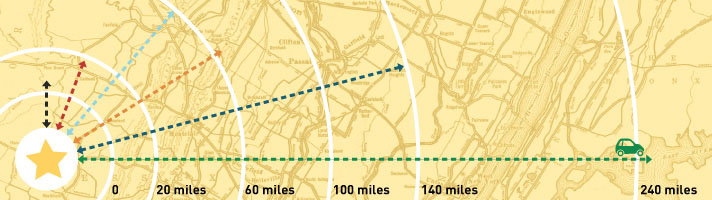
You want to buy an electric car but you’ve got visions of being stranded in the middle of nowhere. There is data to suggest that even though there aren’t charging stations on every corner today, it is likely the distance you travel to perform your daily commute and errands is well within the range of today’s electric cars.
In the past few years automakers have made a serious commitment to electric cars, but a phenomenon called “range anxiety” still persists among the public. It is the fear that you will run out of power far from a charging station. Anyone who has ever run out of gas on a lonely road can relate to why the threat of this might cause anxiety.
Right now the national infrastructure to charge electric cars lags behind the enthusiasm for and production of them. This is thought to hinder the consumer who might be interested in an electric car from actually purchasing one.
But there is hope. Not only is the infrastructure to charge electric cars improving rapidly, but some new models about to come on the market have incredible ranges. Tesla’s Model S for example, boasts a range of up to 300 miles. There are also Plug-in Hybrid Electric Vehicles, or PHEVs, that run on electricity and gas, so you can always stop at a gas station in case of emergency. Most fully electric cars, or EVs, currently for sale in the US travel from 60 - 100 miles on a charge, with the Teslas potentially going up to 300. (source) While the Tesla Model S is still very expensive at $49,900 after $7,500 federal tax credit for electric cars, its vastly improved range bodes well for the future of all electric cars.
Electric cars are likely to be charged at least once a day - overnight at home. So with most EVs that gives you 60 - 100 miles to drive per day. This is where range anxiety comes in.
A cool head and hard facts are the antidotes to most anxiety, and the same is true here. If you want a fully electric car, you should ask yourself a couple of questions:
‘Does my family have more than one car?’ and ‘How far is my daily commute?’
Many two car families interested in an electric car could use the EV for commuting and light errands, and use their second car for road-trips. Single car families may lean toward a reasonably priced PHEV like a Prius with a base price of $24,000 - $29,805.
It’s important that you don’t just estimate how far your daily commute is; you must measure it. On your next workday, record how far you actually drive on your odometer. For most people, this should fall well within the range of today’s electric cars.
Approximately 95% of car commuters in the U.S. travel less than 40 miles to work, with the average commute being being 13.6 miles, according to data from the National Household Travel Survey of 2009, analyzed in a study by Garrett Fitzgerald and Rob van Haaren, doctoral students at the school of Engineering and Applied Science at Columbia University. Those figures represent one-way commutes, but that still means that an average round trip commute is well within the range of the electric cars on the market.
Knowing the facts about electric cars means you can let go of that range anxiety and relax . They can get you nearly anywhere you want to go, and the growing infrastructure is making it easier to go farther everyday. Besides, freedom from oil is invigorating!
May 6th, 2012 | By Aubrey Yee
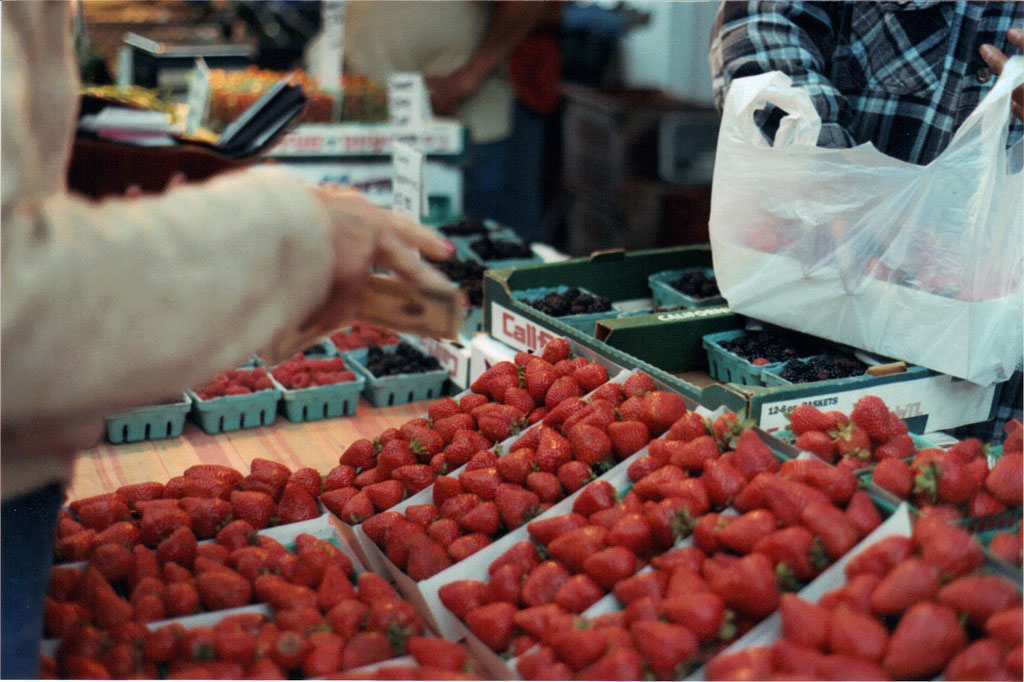
Thousands more farmer’s markets are getting ready to accept food stamps as a form of payment. As part of the USDA’s (US Department of Agriculture) mission to get Americans eating more healthy, fresh food, they have been working to encourage the use of EBT (Electronic Benefit Transfer - another term for “food stamps”) at the markets.
Today less than 25% of the nation’s 7,000 registered farmers markets accept EBT as payment. But a recent report from the USDA shows that spending at the farmer’s markets under the Supplemental Nutrition Assistance Program (SNAP) has jumped 400%. With more markets coming online to accept EBT, those spending figures are expected to increase. The trend is great for farmers and for those who have traditionally been unable to afford to buy local produce at the markets.
In May of this year, the USDA announced plans to begin allocating funds to the states that have the highest number of farmer’s markets without the ability to access EBT. The funds will be used to help those markets purchase the wireless point-of-sale technology that is needed to run the EBT cards as a form of payment. The $4 million fund aims to bring some 4,000 more markets online. California is the recipient of one of the largest grants of $426,945 to service 687 markets (Associated Press).
The USDA website has a search function to find the farmers market nearest you. And you can narrow the search down to which markets accept subsidized payments. With its innovative approach the USDA has made supporting local farmers and eating healthy, locally grown food just a little bit easier.
May 1st, 2012 | By Nicole Rogers
Ecodriving is a modern and efficient way of driving that emphasizes fuel efficiency, speed, and safety. It is widely practiced in Canada and Western Europe, but still catching on in the US. Some ecodriving tips work better with a manual transmission, but anyone can ecodrive. Whether you are in a commercial truck or hybrid vehicle, ecodriving techniques improve gas mileage. In challenging economic times, improving gas mileage saves money and decreases our collective dependence on oil.
For more detailed driving tips from passionate ecodrivers, check out our post on Hypermiling. Ecodriving and Hypermiling are often mentioned in the same breath. They overlap in many ways and both aim to boost fuel efficiency, but some hypermilers take matters to extremes.
Our post included beginner hypermiling techniques, but there are much more advanced hypermiling techniques that aren’t recommended for use off the racetrack or the test track. If you are curious, you can check out some examples of extreme and futuristic hypermilers here.
The Golden Rules of Ecodriving, according to Ecodrive.org:
Anticipate Traffic Flow
Get used to reading the traffic far ahead of you and anticipate the movement of traffic ahead of you as much as possible. Give yourself three seconds to the car in front of you to minimize the need to suddenly brake. Use momentum and coast as much as possible, as covered in our Hypermiling post. Different techniques can be used to accomplish this. Ecodrive.org lists some here.
Maintain a Steady Speed at a Low RPM
Think flow. You want to glide through traffic smoothly and safely with minimal braking and acceleration. Drive at a low RPM and the highest possible gear. Avoid rapid acceleration and braking, as they lead to increased fuel burn. Use cruise control when applicable.
Up-Shift Early
If you have a manual transmission, shift earlier and accelerate at a lower rpm.
Check Tire Pressure Frequently - at least once a month
Check your car’s manual for correct tire pressure. Tire pressure alone can work wonders for improving your gas mileage in the long haul.
Limit Any Extras - Extra Energy Costs Fuel, and Therefore Money
Air conditioning always burns more fuel, so use it only when necessary. The same goes for any other electrical extras you use in your car.
Avoid dead weight like heavy equipment you forgot in your trunk, and aerodynamic drag like an open sunroof on the highway.
Of course, you need to be comfortable, so there is no need to drive around with all of the windows up and no air-conditioning on a hot day. Generally speaking, on the highway at speeds of 50 mph and above, air-conditioning is a more fuel efficient option. When cruising around town at relatively low speeds, turning the a/c off and rolling the windows down is the better option.
Hungry for more?
Of course, a few tips like this are helpful, but these are just the tip of the iceberg. Ecodriving Solutions specializes in training fleet drivers (like bus and truck drivers) to ecodrive, potentially saving participating corporations and government departments 6-24% on fuel costs. They provide a free demo for the average driver on their site, and have an excellent and prolific blog covering ecodriving.
Apr 20th, 2012 | By Aubrey Yee

eat less. give more. go halfsies. - it’s a straightforward slogan with a grand mission.
Halfsies is a “social initiative offering a choice to restaurant-goers that provides a healthier meal portion, reduces food waste and supports the fight against hunger.”
Their informational booklet explains how American’s portion sizes have grown over the years leading to an over consumption of daily calories and a nationwide obesity epidemic.
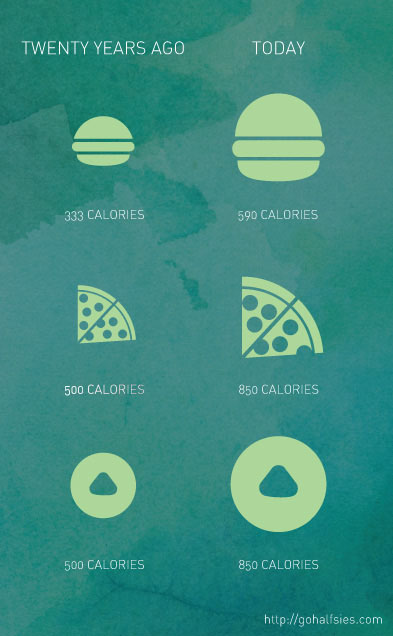
They also explain that some 40% of our food in America is wasted; it is not consumed. That means that every day Americans waste enough food to fill the Rose Bowl Stadium.
If only 5% of our food scraps were recovered, it would be enough to feed 4 million people for a day according to the FDA.
By offering a half-size portion option in participating restaurants, Halfsies aims to educate the public about these issues while tackling the problem of food waste head on and getting donations to the non-profits who are addressing world hunger.
Apr 10th, 2012 | By Nicole Rogers
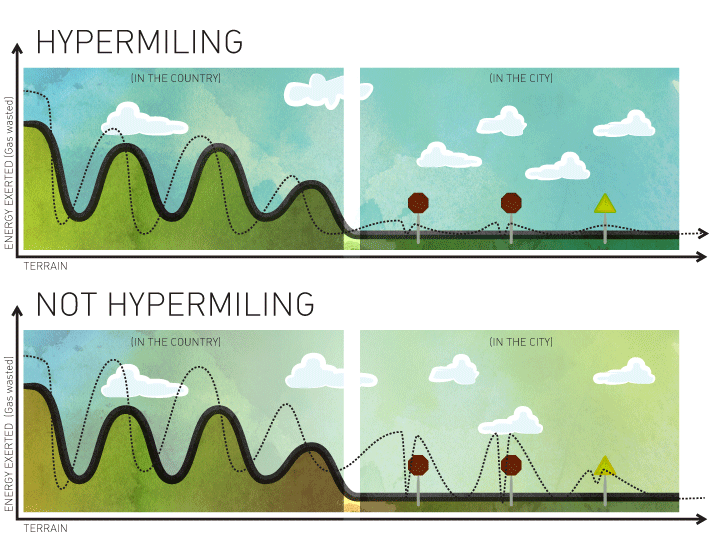
What is Hypermiling?
Strictly speaking it is the act of improving fuel mileage by the use of certain driving techniques.
People who hypermile are called hypermilers. Beginner hypermilers can hope to improve their fuel efficiency by a few mpgs.
How Do I Do It? (Beginner Tips)
Technically, the best way to hypermile is not to drive. Ride your bike, walk, or take public transportation. After that, manual transmissions usually give better gas mileage than automatics.
For those of us who must drive, I like to relate hypermiling tips to riding a bike efficiently in traffic. Driving your car like you would ride a bike = good hypermiling. Driving your car like a New York City cab driver (accelerate, slam on brakes, repeat until car sick) = bad hypermiling.
- If you were just starting to pedal your bike after a stop light, you wouldn’t (and couldn’t) peel out. Do the same in your car. Accelerate slowly, do not drag race.
- Observe the speed limit. According to the US Department of Energy, “You can assume every 5 mph over 60mph is like paying an additional $0.31 per gallon for gas.” Pick a speed and stay at that speed as much as safely possible.
- Use cruise control when you are on the highway. It helps maintain a consistent speed and in most cases saves gas. You might burn a little more going up hill, but you will increase your efficiency on the way down.
- Decrease the amount of times you brake, just as you would on a bike. The more you keep your momentum up, the less you will have to work on the way up the next hill. Obviously you have to brake sometimes, but be aware of the traffic far ahead of you and practice easing up on the accelerator and coasting well ahead of time so you don’t end up slamming on the brakes. The less you brake the better in terms of hypermiling. It’s common sense on one hand, but most people can get better at this and improve fuel economy.
- Don’t drive around with heavy objects in your car. Again, common sense, but every little bit helps.
- Turn off your air conditioning. It can increase your mpg up to 30%.
- Keep your tires properly inflated. For every three pounds below their recommended pressure, your fuel economy drops 1 percent. Tires can lose 1 pound of pressure per month, so check the pressure regularly and definitely before long trips. American Council for an Energy-Efficient Economy.
Will my hypermiling annoy other drivers?
These mild hypermiling techniques, should be largely inconspicuous. Be courteous and aware of your surroundings, and it’s doubtful anyone will know you are hypermiling. Of course, some drivers are easily annoyed. Just be confident in the knowledge that you are saving money and decreasing your consumption of oil. It can be fun, and even meditative, to bring this heightened level of consciousness into your driving. Good luck!
Apr 8th, 2012 | By Aubrey Yee
What is biodynamic farming?
There’s organic, and then there’s biodynamic. Taking organic farming a few steps further, biodynamic farming incorporates social, ecological and economic sustainability into consideration for the total health of the soil as well as the plants and animals that are cultivated on it.
Based on the teachings of Dr. Rudolph Steiner, who also founded the Waldorf school movement, the foundation of biodynamic agriculture is in Steiner’s philosophical ideals which he labeled “anthroposophy”. In this system, nature is seen as an interconnected whole organism with its own rhythm to be observed, respected and supported.
From the Biodynamic Farming Association: “Biodynamics is thus not just a holistic agricultural system but also a potent movement for new thinking and practices in all aspects of life connected to food and agriculture.”
Following phases of the moon, consideration of soil microorganism health and using precise mixtures of minerals and biological composts to replenish the system, biodynamic farming aims to create an ecosystem that needs little to no imports to maintain its health and produce delicious food.
By supporting the total “immune system” of a piece of land rather than just the particular symptoms of a crop, like pests or low yields, biodynamic farming seeks to build a robust and healthy complex and adaptive environment.
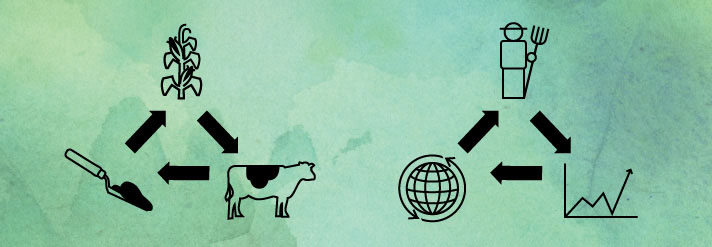
The Demeter Association founded in 1985 has taken on the lofty mission of “healing the planet through agriculture.” They describe the biodynamic style of agriculture as a perfect example of a truly sustainable closed-loop system, “It is the biodiversity of the farm, organized so that the waste of one part of the farm becomes the energy for another, that results in an increase in the farm’s capacity for self-renewal and ultimately makes the farm sustainable.”
Biodynamic farms and vineyards can now be found all over the country and internationally. For those interested in learning more, check out these online resources or attend a Biodynamic farming conference this November in Madison, Wisconsin.
Apr 3rd, 2012 | By Aubrey Yee
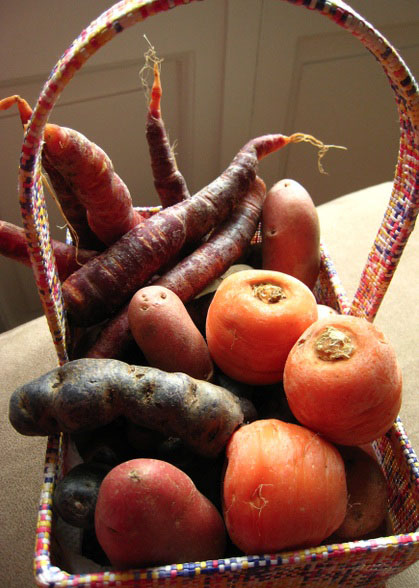 Once upon a time carrots were purple. Really they were! In Roman times, almost all carrots were purple or white. It was a mutant variety that had the orange color and sweeter taste. It took some industrious Dutch farmers several generations of breeding to select out the orange carrot that we have come to expect today.
Most modern plants and livestock varieties share a similar history of selective breeding. While we only see two or three types of potatoes in a typical American grocery store, in the South American Andes there are some 5,000 potato varieties grown.
“Heirloom” or “heritage” plants and livestock breeds are important to maintaining food resilience. In the world of livestock, heritage animals were bred over time to produce more milk, gain weight quickly, and withstand the conditions of typical industrial production such as more cramped quarters and confinement. The heritage breeds on the other hand are often more capable of withstanding diseases and environmental changes, qualities that may be important in the future.
The American Livestock Breeds Conservancy is one of the non-profits focused on conserving the genetic heritage of over 180 breeds of livestock and poultry.
The Seed Savers Exchange is a non-profit that saves and distributes heirloom plant varieties. They believe, “A vibrant, diverse plant world is necessary for our survival, but that world is increasingly threatened by climate change, habitat loss, and over-exploitation.” The Millennium Seed Bank Partnership estimates that some 60,000 to 100,000 plant varieties are currently under threat of extinction.
In an effort to shift the tide and preserve the genetic diversity of plants in cultivation, the Seed Savers have a library of resources and an online store and catalog where you can purchase heirloom seeds for your garden. Try out some white cucumbers or delicious heirloom tomato varieties to do your part in propagating rare seeds and sowing sustainability.
Oct 20th, 2011 | By jeff
Although Plug In America says that there are fewer than 15,000 electric cars on America’s roads, that hasn’t stopped some business owners from installing chargers for all-electric cars.
In an article published on October 17 in the Wall St. Journal, James R. Hagarty and Mike Ramsey take a look at what some business owners and companies consider an investment in the future.
Oct 4th, 2011 | By jeff
Daniel Yergin, author of "The Prize" and "The Quest," discusses the fear of "peak oil" in this article in the Wall Street Journal. This is the fifth time in modern history that there has been widespread fear that the world is running out of oil. But is that really the case?
Continue Reading