Subscribe to our Newsletter
Get regular stories, tips and solutions from Sustainable America and opt-in to receive roundups of the latest food and fuel news.



May 22nd, 2012 | By Aubrey Yee
 In New York City, a innovative new program aims to bring healthy, fresh food to food pantries and the citizens they serve. Just Food is a New York City non-profit that “connects communities and local farms with the resources and support they need to make fresh, locally grown food accessible to all New Yorkers.”
Through Local Produce Link, some 44 farmers are connected with New York’s Food Pantries to provide fresh produce. Each food pantry receives approximately 200 lbs. of mixed vegetables each week, about 6 to 10 boxes. The produce varies with the season and often includes more unusual vegetables like bok choi (an asian cabbage) that patrons of the food pantry can try.
Farmers are paid by the pound through funding from the New York State Department of Health’s Hunger Prevention and Nutrition Assistance Program (HPNAP).
Just Food also hosts community cooking programs and provides resources for recipes and nutrition information to help food pantry clients learn how to prepare the vegetables they receive in healthy ways. They host Farm Visits so that food pantry volunteers and clients can meet the farmers that grew their food, making the connection from farm to table.
May 21st, 2012 | By Aubrey Yee

Once upon a time food was eaten in season and in place. That meant no strawberries in winter, no pineapples either. It also meant you’d be hard pressed to find sushi in Las Vegas. Cheap and abundant oil changed all that. And surprisingly not very long ago.
It was really the advent of the modern American interstate roadways in the 1950’s pioneered by Eisenhower that created a way for farmers to cheaply and quickly get their food from farms to tables far away. Today, food is often shipped thousands of miles, or in the case of the sushi in Las Vegas, flown to far flung destinations in refrigerated cargo containers.
Upon signing the “National System of Interstate and Defense Highways” Act into law, Eisenhower is quoted as saying, “More than any single action by government… this one would change the face of America… Its impact on the American economy – the jobs it would produce in manufacturing and construction, the rural areas it would open up – was beyond calculation.”
The new roadways combined with cheap and abundant oil to power trucks for shipping have completely changed the way American’s eat. We think nothing of seeing strawberries in the grocery store on a cold winter morning and nothing of the ability to order New Zealand Lamb on a menu. These are luxuries we have come to expect. But many who subscribe to the locavore movement say that to have a truly Sustainable America, we need to get used to eating food grown closer to home.
Locally grown whole foods are more affordable, support local businesses, have lower carbon footprints as a result of less transportation and are all around healthier than mass produced, processed foods. That means eating in season and eating according to place.
May 20th, 2012 | By Nicole Rogers

Imagine going to your morning spinning class, getting a great workout, and producing clean energy, all before breakfast. This isn’t some dream of the future – it’s something you could do tomorrow at certain gyms across the country.
That’s right, all of that energy you expend in your workout can be converted into usable electricity. Several companies are already making it possible. Based in Seattle, PlugOut specializes in making cardio equipment that returns electricity to the gym’s electrical system by plugging the standard three prong power cord that is included with the unit directly into a standard outlet. If the building isn’t using any electricity it will be returned to the power grid, essentially spinning the building’s meter backwards.
For gyms with fleets of cardio equipment who may not want to invest in all new equipment there are companies like ReRev that retrofit existing equipment to do the same thing. According to ReRev’s website, a typical 30-minute workout produces 50 watt hours of clean, carbon-free electricity. That’s enough electricity to power a laptop for one hour. Though that may not sound like a huge amount, think of how much cumulative power is generated by the legions of people who go to the gym on any given day.
Using PlugOut equipment, Portland’s Green Microgym is focused on maximizing energy creation. According to their website, through energy creation and saving culture, in 2010 they generated 36% of their own electricity, and saved 37,000 Kilowatt hours or 85% (compared to traditional gyms per square foot). Those 37,000 Kilowatt hours saved are equal to 74,000 pounds of carbon emissions, 81,400 miles not driven, or 15 acres of trees planted.
PlugOut equipment can be found at fitness centers nationwide, and ReRev has an impressive roster of universities, private gyms and organizations (including the US Air Force) who use their equipment. With any luck, and maybe a nudge from customers in the right direction, your local gym will recognize the potential to save energy and money. With this new technology on your side you could be on the path to becoming a lean, green, alternative energy machine.
May 17th, 2012 | By Aubrey Yee
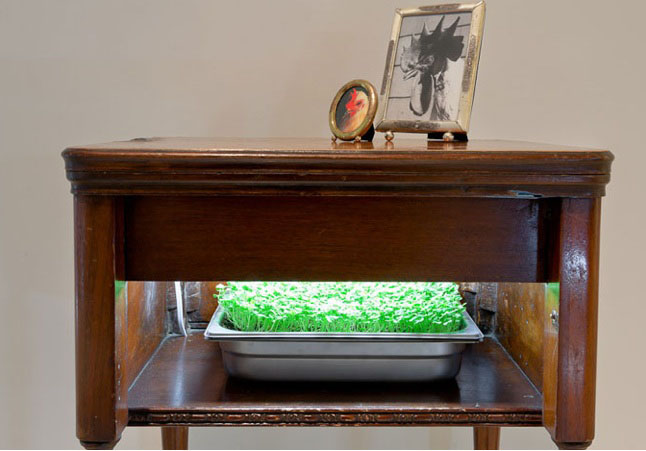
8 Extraordinary Greens is a visionary project by artist Jenna Spevack. By constructing 8 pieces of furniture - a chair, kitchen cabinet and suitcase among others - she aims to encourage ideas about how to use our most domestic of objects in new ways to grow food. What could be more local than a dining chair that doubles as a salad garden?
Jenna’s aim is to: provide healthy greens to extraordinary people with ordinary incomes. To do this, she developed a sub-irrigated system for growing micro-greens - energy packed, edible plants, that uses lights and stainless steel growing trays incorporated into the furniture.
On the one hand an architectural design project, this is on the other hand an abstracted artist comment on the different values we place on food. In one exhibit, she explores Aesop’s fable “The Cock and the Jewel” which is a tale with lessons on relative value.
At her “farmstand” exhibit, visitors have the option to purchase 8 different micro-greens. You determine the price of your own exchange based on a set of choices that will support local, urban agriculture non-profits in New York city. Each transaction is recorded in the form of a “receipt” signed by both the visitor and the artist. A duplicate “receipt” is created and hung in the gallery to show the collective nature of all the different choices and donations made.
The project is on display now through June 2nd at the Mixed Greens Gallery in NYC.
May 16th, 2012 | By Nicole Rogers
This week the US Navy introduced a new version of its MMOWGLI online gaming project. MMOWGLI stands for Massive Multiplayer Online Wargame Leveraging the Internet. The project uses the fictional future scenario shown in the promotional video below to encourage players around the world to join the game, and use their individual expertise to devise solutions to help our military meet its demands while decreasing its dependence on fossil fuels – and anyone can play.
http://youtu.be/wKXrIWsuxnE
The game will be “an examination of what our energy future looks like if we fail to act now,” said Cmdr. James Goudreau, director of the Navy Energy Coordination Office. “Every day that petroleum prices increase, it erodes our ability to train for and execute operations that our nation demands of us. Little by little, that results in decreased combat capability, and that is something we simply cannot accept.”
In essence, the game allows multiple users to interact and collaborate on ideas online, moving through the game by responding to a series of “Call to Action” videos. Talking Points Memo provides a clear explanation of the game here.
In a move that could derail the project, the House Armed Services Committee voted last week to ban the Department of Defense from purchasing alternative fuels that cost more than “traditional” fossil fuels. That would eliminate the purchase of biofuels, at least for the near future. The small biofuel industry cannot compete price-wise with the huge petroleum industry at this point. It was thought that the military’s use of biofuels would help bolster the biofuel industry and drive biofuel prices down.
With programs like the Green Fleet, the Green Strike Force, and their grand goal to get half the energy for Naval shore installations from alternative energy sources, the US Navy is beginning to sound like a group of real-life superheros. Let’s hope they aren’t thwarted at the last moment!
May 15th, 2012 | By Nicole Rogers
May is National Bike Month! If you haven’t dusted off your bike yet this year (or this decade), here’s some inspiration.
- A new report</a> from the League of American Bicyclists, Sierra Club, and National Council of La Raza (NCLR) shows that cyclists in the U.S. save $4.6 billion every year on gas and transportation costs.
- The same report states that if American drivers replaced just one four-mile car trip with a bike every week for a year, it would save more than 2 billion gallons of gas.
- 82% of bicycle commuters believe their health has improved since they started bicycle commuting.
Enough facts and figures. The best part of cycling is how it feels. Let this compilation of the films in the 2012 Bicycle Film Festival remind you. The festival runs in 21 cities throughout the year. The next one is in New York from June 26 to July 1.
http://youtu.be/w3lc-lEYOLk
May 10th, 2012 | By Nicole Rogers

Global consumption of fish has doubled since the 1970s. In the US we’ve witnessed a boom in the popularity of sushi restaurants, the Mediterranean Diet is all the rage, and the benefits of omega-3 fatty acids are hailed on every talk show. It’s no wonder more Americans are seeking fish is an important part of a healthy, well-rounded, not to mention delicious diet.
As healthy as fish can be for our bodies, fishing can be a real problem for our oceans. Overfishing and other unsustainable fishing practices are the greatest current threat to our oceans, according to Ocean Wise. Aside from direct damage to the ocean, the carbon footprint of fishing can be huge. “Over 95% of the seafood consumed by the community of Santa Barbara, including UCSB, is imported. Additionally, at least 95% of the seafood caught locally is exported,” reports the Associated Students Coastal Fund. And Santa Barbara is a coastal area with fisheries nearby! Imagine the energy expenditure, not to mention the cost, of such a process.

Enter the Santa Barbara Sustainable Seafood Program. Run by the Santa Barbara Museum of Natural History, their mission is to help the public make more informed decisions about the seafood we eat. Local restaurants and markets gain free membership to the program by taking a pledge to take steps to avoid unsustainable seafood. In return, the program helps members make the switch to sustainable seafood, and promotes member businesses by letting the community know that they provide consumers with an alternative to unsustainable seafood. Each restaurant and market gets a certificate and a sticker for their window to signify their participation in the program. In addition the Sustainable Seafood Program promotes participating businesses through exhibits, banquets and festivals held at the Ty Warner Sea Center.
An exciting development this spring: A Community Supported Fishery Program. Like a farm CSA, the CSF will provide local seafood shares directly to the consumer. The program, funded by the Associated Students Coastal Fund, starts this spring at the University of California Santa Barbara, and will go community-wide next year.
A local fisherman’s perspective on the CSF:
“California fisheries have some of the most stringent regulations and well managed fisheries in the world, and we (fishermen) embrace those regulations if it protects our marine ecosystem while providing food for the community. A CSF provides an opportunity for us to fish less and make more money to support our families.” - Stephanie Mutz, a commercial fisherman and Research Coordinator of Commercial Fishermen of Santa Barbara
The future looks bright for a program that helps local fishermen, the community and the ocean.
May 9th, 2012 | By Nicole Rogers
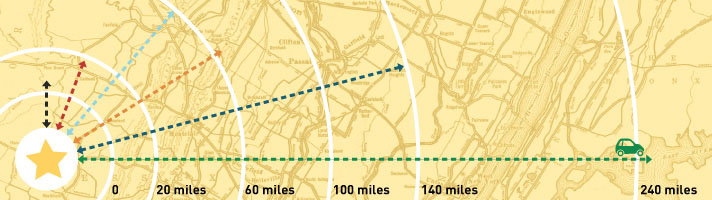
You want to buy an electric car but you’ve got visions of being stranded in the middle of nowhere. There is data to suggest that even though there aren’t charging stations on every corner today, it is likely the distance you travel to perform your daily commute and errands is well within the range of today’s electric cars.
In the past few years automakers have made a serious commitment to electric cars, but a phenomenon called “range anxiety” still persists among the public. It is the fear that you will run out of power far from a charging station. Anyone who has ever run out of gas on a lonely road can relate to why the threat of this might cause anxiety.
Right now the national infrastructure to charge electric cars lags behind the enthusiasm for and production of them. This is thought to hinder the consumer who might be interested in an electric car from actually purchasing one.
But there is hope. Not only is the infrastructure to charge electric cars improving rapidly, but some new models about to come on the market have incredible ranges. Tesla’s Model S for example, boasts a range of up to 300 miles. There are also Plug-in Hybrid Electric Vehicles, or PHEVs, that run on electricity and gas, so you can always stop at a gas station in case of emergency. Most fully electric cars, or EVs, currently for sale in the US travel from 60 - 100 miles on a charge, with the Teslas potentially going up to 300. (source) While the Tesla Model S is still very expensive at $49,900 after $7,500 federal tax credit for electric cars, its vastly improved range bodes well for the future of all electric cars.
Electric cars are likely to be charged at least once a day - overnight at home. So with most EVs that gives you 60 - 100 miles to drive per day. This is where range anxiety comes in.
A cool head and hard facts are the antidotes to most anxiety, and the same is true here. If you want a fully electric car, you should ask yourself a couple of questions:
‘Does my family have more than one car?’ and ‘How far is my daily commute?’
Many two car families interested in an electric car could use the EV for commuting and light errands, and use their second car for road-trips. Single car families may lean toward a reasonably priced PHEV like a Prius with a base price of $24,000 - $29,805.
It’s important that you don’t just estimate how far your daily commute is; you must measure it. On your next workday, record how far you actually drive on your odometer. For most people, this should fall well within the range of today’s electric cars.
Approximately 95% of car commuters in the U.S. travel less than 40 miles to work, with the average commute being being 13.6 miles, according to data from the National Household Travel Survey of 2009, analyzed in a study by Garrett Fitzgerald and Rob van Haaren, doctoral students at the school of Engineering and Applied Science at Columbia University. Those figures represent one-way commutes, but that still means that an average round trip commute is well within the range of the electric cars on the market.
Knowing the facts about electric cars means you can let go of that range anxiety and relax . They can get you nearly anywhere you want to go, and the growing infrastructure is making it easier to go farther everyday. Besides, freedom from oil is invigorating!
May 6th, 2012 | By Aubrey Yee
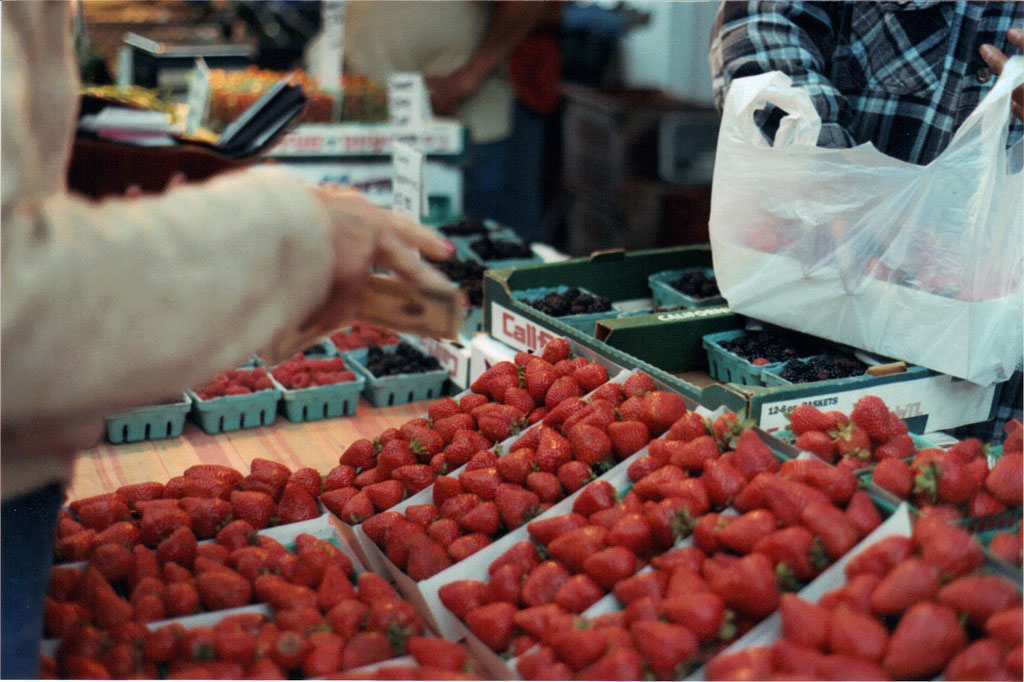
Thousands more farmer’s markets are getting ready to accept food stamps as a form of payment. As part of the USDA’s (US Department of Agriculture) mission to get Americans eating more healthy, fresh food, they have been working to encourage the use of EBT (Electronic Benefit Transfer - another term for “food stamps”) at the markets.
Today less than 25% of the nation’s 7,000 registered farmers markets accept EBT as payment. But a recent report from the USDA shows that spending at the farmer’s markets under the Supplemental Nutrition Assistance Program (SNAP) has jumped 400%. With more markets coming online to accept EBT, those spending figures are expected to increase. The trend is great for farmers and for those who have traditionally been unable to afford to buy local produce at the markets.
In May of this year, the USDA announced plans to begin allocating funds to the states that have the highest number of farmer’s markets without the ability to access EBT. The funds will be used to help those markets purchase the wireless point-of-sale technology that is needed to run the EBT cards as a form of payment. The $4 million fund aims to bring some 4,000 more markets online. California is the recipient of one of the largest grants of $426,945 to service 687 markets (Associated Press).
The USDA website has a search function to find the farmers market nearest you. And you can narrow the search down to which markets accept subsidized payments. With its innovative approach the USDA has made supporting local farmers and eating healthy, locally grown food just a little bit easier.