A mechanical engineer with a sustainable agricultural robot in the field. Photo by ThisisEngineering on Unsplash.
A robot rolls between rows of crops, camera scanning the ground. It spots a weed, classifies it in milliseconds, and destroys it with a targeted pulse, leaving the surrounding plants, and the soil beneath them, untouched.
Systems like this are already being used, and they’re part of a broader wave of emerging agricultural technology that's starting to deliver measurable sustainability gains across AI, robotics, gene editing, and indoor farming.
Here's a look at where things stand.
Precision agriculture and AI
The basic principle is this: instead of treating an entire field uniformly, data can help farmworkers make decisions at the level of individual plants or rows. Computer vision systems mounted on tractors or drones identify weeds and detect disease in real time. AI classifies the problem, and a mechanical or chemical response targets only what needs treating. AI-driven targeted sprayers have been shown to reduce pesticide use by up to 90% in some cases—a significant reduction in chemical exposure for both the land and the workers on it.
The impact goes beyond pest management: A systematic review of 95 studies found that AI and machine learning-driven crop management can deliver up to 25% yield increases, 22% water savings, and 28% less fertilizer use, with nitrogen runoff dropping by as much as 35%. Networks of ground-based sensors can also provide continuous readings, tracking soil moisture, microclimate conditions, and plant stress continuously. Drones add an aerial perspective, and in grazing land, autonomous robots like SwagBotS are helping manage cattle while monitoring for soil degradation.
These technologies give farmworkers a much more detailed picture of what's happening across a field—surfacing patterns and conditions that weren't previously visible, alongside the kind of granular information that used to require constant manual scouting to piece together.
That said, access remains uneven. Mobile AI apps can deliver 15–30% gains for smallholder farmers, but the most powerful platforms still require significant capital investment and digital infrastructure, favoring large operations.
Vertical farming
Research shows that vertical farms can produce significantly higher yields per square meter than open-field agriculture, with dramatically better water efficiency—though so far, those gains are largely limited to leafy greens and herbs.
And there are other real trade-offs. That same research found that greenhouse gas emissions from vertical farms are currently higher than conventional systems, driven almost entirely by the energy demands of indoor lighting and climate control. The sustainability case for vertical farming depends on solving this energy problem.
There are promising directions. Dynamic environmental controls, like adjusting light, temperature, and CO₂ levels in real time rather than running systems at fixed settings, could meaningfully improve both productivity and operating costs. And integration with renewable energy and continued advances in LED efficiency are considered essential for making the model viable long-term.
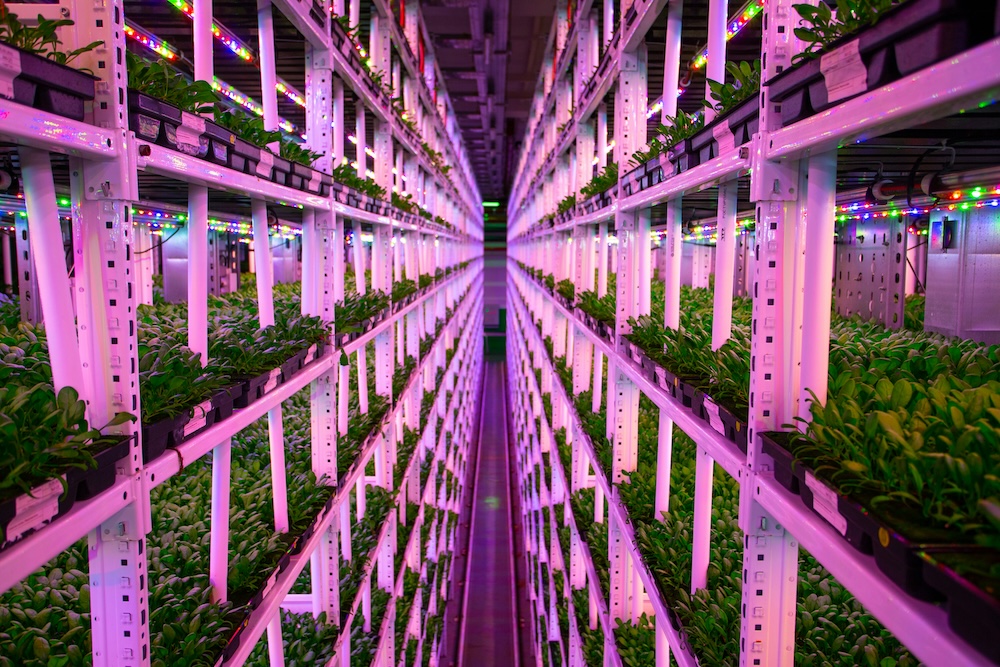
A sample of organizations and certifying bodies recognizing the Spinach grows on a vertical urban farm. Photo by Petr Magera on Unsplash
Gene editing for climate resilience
While precision agriculture optimizes how we manage today's crops, gene editing is working to make the crops themselves more resilient. Using tools like CRISPR/Cas9, scientists can make targeted edits to a plant's own DNA, improving drought tolerance, heat resilience, or salinity resistance. As the BBC has reported, these edits don't introduce any foreign genetic material, which distinguishes them from traditional GMO approaches and simplifies regulatory pathways in several countries.
Successful modifications have been demonstrated in wheat, rice, maize, and soybean—staple crops that billions of people depend on. The practical challenge now is bridging the gap between lab-demonstrated results and commercially available, field-validated varieties. For a deeper look at where this is headed, this segment on CRISPR and food production is worth a listen.
Alternative proteins
Alongside production-side innovation, a growing portfolio of >alternative protein sources—cultivated meat, insect protein, mycoprotein, and microalgae—is being developed as supplements to conventional animal agriculture. We've covered some of these before, including the potential of mushrooms and legumes and pulses as sustainable food staples.
Can sustainable farming technology reach everyone?
The technology is here, or close to it. Robots are zapping weeds. Sensors are guiding irrigation. Gene-edited crops are in field trials. New protein sources are emerging. The bigger question is who gets to use these new technologies and on what terms. Reporting from the Washington Post suggests that these technologies are drawing younger workers into agriculture. That same reporting also raises real concerns: job displacement, corporate consolidation, energy use, and questions around data ownership and privacy.
Projects like FarmBot, an open-source automated gardening system, show what more accessible agricultural technology could look like on a backyard scale. But scaling that accessibility, through training, affordable access, and intentional policy, has to be part of the equation if these innovations are going to improve sustainability broadly.