Subscribe to our Newsletter
Get regular stories, tips and solutions from Sustainable America and opt-in to receive roundups of the latest food and fuel news.



May 25th, 2012 | By Nicole Rogers
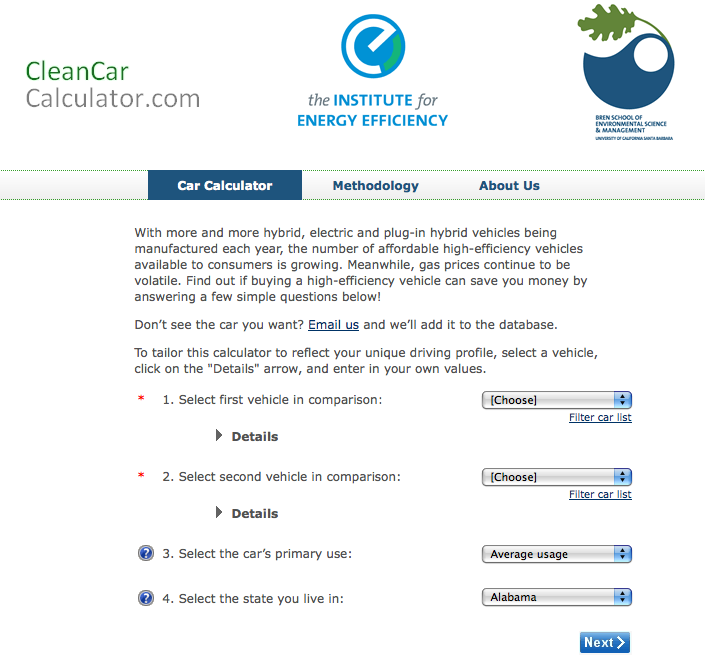
Until now shopping for a high fuel efficiency car, like an electric or hybrid vehicle, could be confusing with overwhelming amounts of data to digest and compare, but students at The Bren School of Environmental Science and Management at The University of California, Santa Barbara have just made it seductively simple.
Enter the Clean Car Calculator: an elegant online calculator that allows the consumer to compare any two high fuel efficiency vehicles on the market, providing a financial and environmental analysis of the cars and even recommending other vehicles to consider given the user’s criteria. The calculator allows the user to adjust for as many or as few variables as desired, like the car’s primary use, percentage of highway miles driven, government tax incentives, etc. One of the most valuable aspects of the calculator is that it determines how long one must own a high fuel efficiency vehicle for it to make economic sense in fuel savings.
The idea for the calculator was inspired by a homework assignment. Project manager Kate Ziemba explains:
The Calculator resulted from an assignment in the Energy and Resource Productivity class taught by Dr. Sangwon Suh at the Bren School that challenged students to understand the return on investment for businesses and consumers to implement energy saving technologies. Students compared lifetime costs and emissions of conventional gas versus high efficiency vehicles. The graduate student developers were surprised to find that hybrids not only paid themselves back in fuel savings, but also that newly released vehicles, such as the Volt and the Leaf, were smart purchases even without a government subsidy.
There you have it! There is more data everyday to show that electric cars and hybrids make sense for the environment and the consumer. But don’t take our word for it - check out the calculator and have fun comparing a few of your favorite green dream cars.
May 24th, 2012 | By Aubrey Yee
 What is Peak Oil?
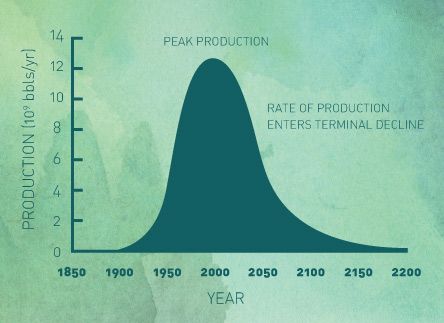
Peak oil is not the end of oil. It’s not as if all the reserves in the world are just going to dry up. Rather, it’s the end of cheap and available oil, something we humans have become quite used to in the last 100 or so years.
EROEI is a term often tossed around in this field of study. It stands for Energy Return on Energy Investment. What this measures is how much energy you create or extract minus the energy you spent during the process. For example, when oil was really cheap and more easily available in 1930, the EROEI was about 100:1. In 2004, when extraction had become much more difficult and costly, it was approximately 11-18:1. That is a significant difference.
When the EROEI is less than 1:1 that energy source becomes what is called an “energy sink” and is no longer feasible from a practical economic perspective. You can’t use more energy to extract the energy that you plan to use, it’s simple math. Peak oil means that the cost to extract oil from the ground will create such low EROEI that oil will no longer make sense as a primary energy source.
This is concerning for many reasons:
It is possible for America to get on a speedy path to sustainability, but it will take a serious and concerted dedication of resources and innovation to achieve real energy and food security. Ready… set… go!
May 24th, 2012 | By Aubrey Yee
I imagine some day hundreds of years from now, when a future humanoid describes the fossil fuel era, they may say something like this:
Humans found the decomposed bodies of long dead organisms big and small buried under the ground. They created a way to burn this sludge and create energy that they used to power all kinds of machines. Unfortunately, the burning of this sludge created all kinds of other problems in the air, water, soil and in the bodies of living beings. Then, the humans realized that there were only so many organisms buried under the ground and they couldn’t keep burning them forever.
http://youtu.be/cJ-J91SwP8w
The term fossil fuels refers to the fuel sources coal, petroleum and natural gas which are all made from the decomposed bodies of once living organisms. It takes millions of years for the bodies of these once living creatures to become the fossil fuels that we use for creating energy today.
We live in a peculiar time. With fossil fuels discovered just a few hundred years ago, we have been depleting a resource that took millions of years to create at a pace that is clearly unsustainable into the future. Yet, until quite recently humankind has not been compelled to change in any significant way. The result is a global economic system that is intimately and perilously dependent on these buried dead organisms.
While there are debates about the reality of Peak Oil, it is clear that we will need to get creative about alternative forms of energy, quickly.
The rising price of oil is unsustainable for America’s economy. In addition, our leaders have acknowledged that our dependency on imported fossil fuels has become a matter of national security. It is clear that alternative renewable energy sources and energy efficiency will be key to creating a sustainable future for America and for the world.
May 23rd, 2012 | By Aubrey Yee
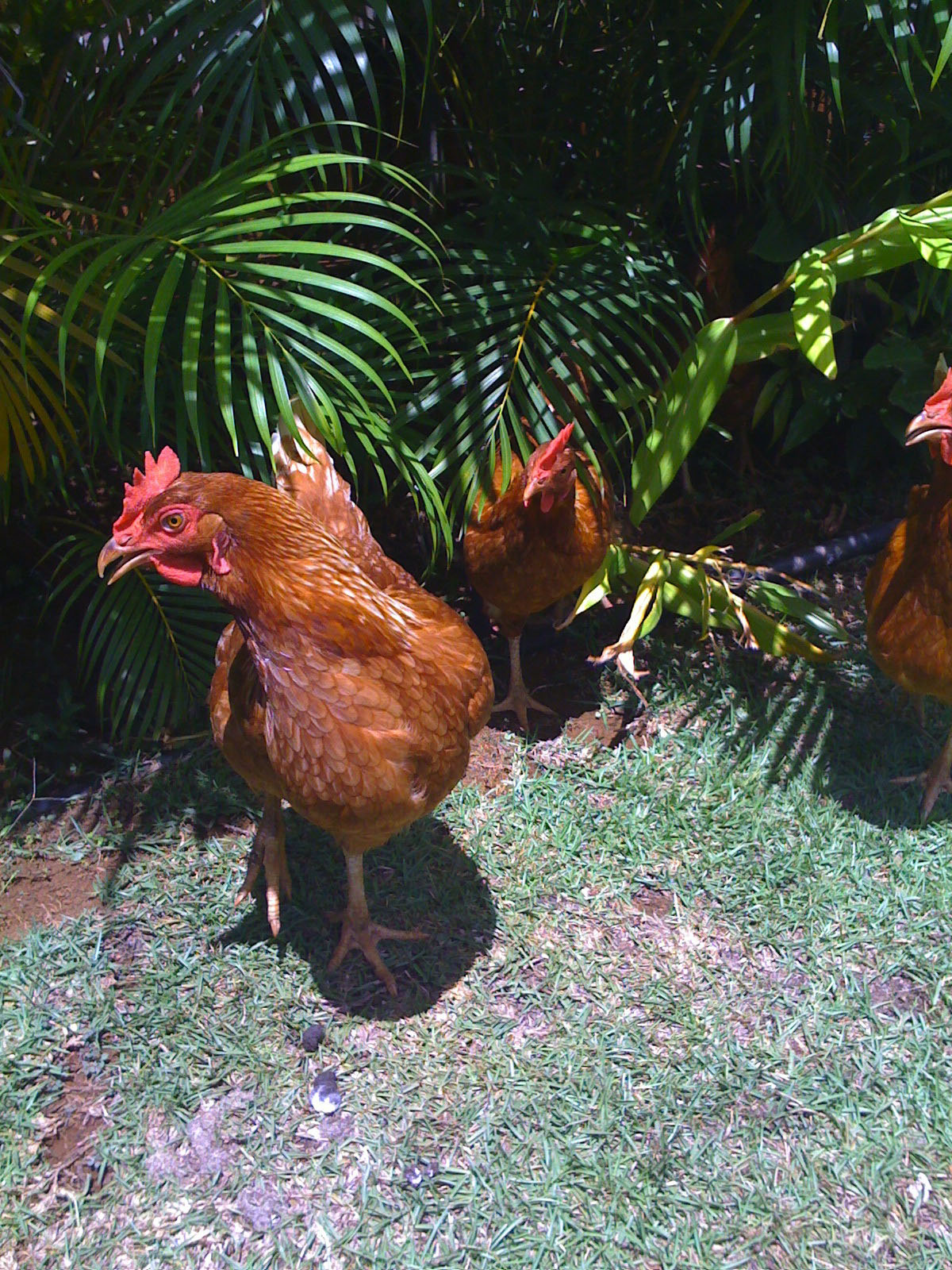 Imagine having access to your own eggs, fresh, every day. When you have your own backyard chickens, you will have access to all the eggs you can eat and you will know exactly what your chickens ate to make those eggs. Chickens are also great upcyclers, they will eat almost all your kitchen scraps - vegetables, fruit, bread, rice… basically anything but chicken!
Many counties have restrictions on livestock, so check to make sure that backyard chickens are legal in your neighborhood before you start. Courtesy to neighbors is also important protocol. Chickens are noisy animals so you want to bu sure that you place your coop out of neighbors ear shot.
When building a coop, a place for the chickens to nest and sleep at night is crucial, and you should plan for a larger enclosure where they can roam and eat bugs and the feed that you give them.

If you want to start with baby chicks, you can buy them online. There are lots of websites that sell different breeds of chicken. If you want a real egg laying machine, check out the Rhode Island Red, but there are also more exotic breeds like the Poodle Chicken… enough said.
If you start with chicks, you’ll want to keep them in a box with a warming lamp for about the first 6 weeks and they will only eat chick started feed until they get old enough to be on their own in the coop.
For the coop and enclosure, make sure you have:
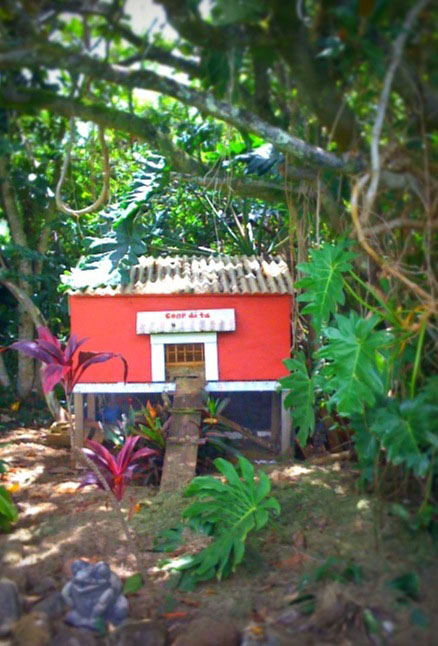 If you have a fully secure enclosure then you don’t have to clip their wings. If your enclosure is just fenced, you will have to clip the chickens wings every few weeks. They are birds and they can fly!
For some great coop designs and more information on caring for your chickens, check out Backyardchickens.com and don’t forget to ask your friends for creative omelet recipes!
<br style=’clear:both;”><br style=’clear:both;”>
May 22nd, 2012 | By Aubrey Yee
 In New York City, a innovative new program aims to bring healthy, fresh food to food pantries and the citizens they serve. Just Food is a New York City non-profit that “connects communities and local farms with the resources and support they need to make fresh, locally grown food accessible to all New Yorkers.”
Through Local Produce Link, some 44 farmers are connected with New York’s Food Pantries to provide fresh produce. Each food pantry receives approximately 200 lbs. of mixed vegetables each week, about 6 to 10 boxes. The produce varies with the season and often includes more unusual vegetables like bok choi (an asian cabbage) that patrons of the food pantry can try.
Farmers are paid by the pound through funding from the New York State Department of Health’s Hunger Prevention and Nutrition Assistance Program (HPNAP).
Just Food also hosts community cooking programs and provides resources for recipes and nutrition information to help food pantry clients learn how to prepare the vegetables they receive in healthy ways. They host Farm Visits so that food pantry volunteers and clients can meet the farmers that grew their food, making the connection from farm to table.
May 21st, 2012 | By Aubrey Yee

Once upon a time food was eaten in season and in place. That meant no strawberries in winter, no pineapples either. It also meant you’d be hard pressed to find sushi in Las Vegas. Cheap and abundant oil changed all that. And surprisingly not very long ago.
It was really the advent of the modern American interstate roadways in the 1950’s pioneered by Eisenhower that created a way for farmers to cheaply and quickly get their food from farms to tables far away. Today, food is often shipped thousands of miles, or in the case of the sushi in Las Vegas, flown to far flung destinations in refrigerated cargo containers.
Upon signing the “National System of Interstate and Defense Highways” Act into law, Eisenhower is quoted as saying, “More than any single action by government… this one would change the face of America… Its impact on the American economy – the jobs it would produce in manufacturing and construction, the rural areas it would open up – was beyond calculation.”
The new roadways combined with cheap and abundant oil to power trucks for shipping have completely changed the way American’s eat. We think nothing of seeing strawberries in the grocery store on a cold winter morning and nothing of the ability to order New Zealand Lamb on a menu. These are luxuries we have come to expect. But many who subscribe to the locavore movement say that to have a truly Sustainable America, we need to get used to eating food grown closer to home.
Locally grown whole foods are more affordable, support local businesses, have lower carbon footprints as a result of less transportation and are all around healthier than mass produced, processed foods. That means eating in season and eating according to place.
May 20th, 2012 | By Nicole Rogers

Imagine going to your morning spinning class, getting a great workout, and producing clean energy, all before breakfast. This isn’t some dream of the future – it’s something you could do tomorrow at certain gyms across the country.
That’s right, all of that energy you expend in your workout can be converted into usable electricity. Several companies are already making it possible. Based in Seattle, PlugOut specializes in making cardio equipment that returns electricity to the gym’s electrical system by plugging the standard three prong power cord that is included with the unit directly into a standard outlet. If the building isn’t using any electricity it will be returned to the power grid, essentially spinning the building’s meter backwards.
For gyms with fleets of cardio equipment who may not want to invest in all new equipment there are companies like ReRev that retrofit existing equipment to do the same thing. According to ReRev’s website, a typical 30-minute workout produces 50 watt hours of clean, carbon-free electricity. That’s enough electricity to power a laptop for one hour. Though that may not sound like a huge amount, think of how much cumulative power is generated by the legions of people who go to the gym on any given day.
Using PlugOut equipment, Portland’s Green Microgym is focused on maximizing energy creation. According to their website, through energy creation and saving culture, in 2010 they generated 36% of their own electricity, and saved 37,000 Kilowatt hours or 85% (compared to traditional gyms per square foot). Those 37,000 Kilowatt hours saved are equal to 74,000 pounds of carbon emissions, 81,400 miles not driven, or 15 acres of trees planted.
PlugOut equipment can be found at fitness centers nationwide, and ReRev has an impressive roster of universities, private gyms and organizations (including the US Air Force) who use their equipment. With any luck, and maybe a nudge from customers in the right direction, your local gym will recognize the potential to save energy and money. With this new technology on your side you could be on the path to becoming a lean, green, alternative energy machine.
May 17th, 2012 | By Aubrey Yee
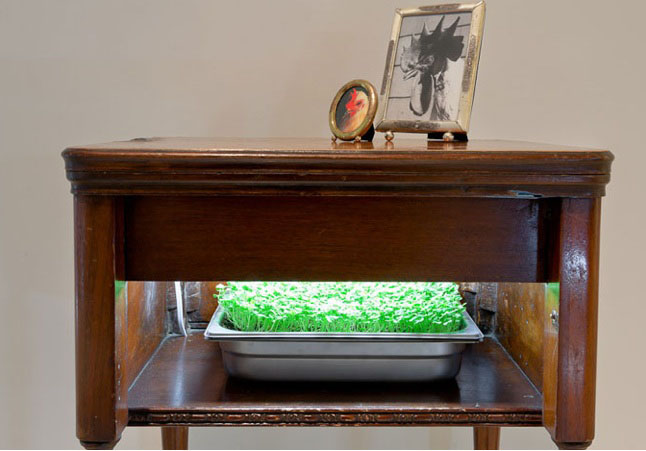
8 Extraordinary Greens is a visionary project by artist Jenna Spevack. By constructing 8 pieces of furniture - a chair, kitchen cabinet and suitcase among others - she aims to encourage ideas about how to use our most domestic of objects in new ways to grow food. What could be more local than a dining chair that doubles as a salad garden?
Jenna’s aim is to: provide healthy greens to extraordinary people with ordinary incomes. To do this, she developed a sub-irrigated system for growing micro-greens - energy packed, edible plants, that uses lights and stainless steel growing trays incorporated into the furniture.
On the one hand an architectural design project, this is on the other hand an abstracted artist comment on the different values we place on food. In one exhibit, she explores Aesop’s fable “The Cock and the Jewel” which is a tale with lessons on relative value.
At her “farmstand” exhibit, visitors have the option to purchase 8 different micro-greens. You determine the price of your own exchange based on a set of choices that will support local, urban agriculture non-profits in New York city. Each transaction is recorded in the form of a “receipt” signed by both the visitor and the artist. A duplicate “receipt” is created and hung in the gallery to show the collective nature of all the different choices and donations made.
The project is on display now through June 2nd at the Mixed Greens Gallery in NYC.
May 16th, 2012 | By Nicole Rogers
This week the US Navy introduced a new version of its MMOWGLI online gaming project. MMOWGLI stands for Massive Multiplayer Online Wargame Leveraging the Internet. The project uses the fictional future scenario shown in the promotional video below to encourage players around the world to join the game, and use their individual expertise to devise solutions to help our military meet its demands while decreasing its dependence on fossil fuels – and anyone can play.
http://youtu.be/wKXrIWsuxnE
The game will be “an examination of what our energy future looks like if we fail to act now,” said Cmdr. James Goudreau, director of the Navy Energy Coordination Office. “Every day that petroleum prices increase, it erodes our ability to train for and execute operations that our nation demands of us. Little by little, that results in decreased combat capability, and that is something we simply cannot accept.”
In essence, the game allows multiple users to interact and collaborate on ideas online, moving through the game by responding to a series of “Call to Action” videos. Talking Points Memo provides a clear explanation of the game here.
In a move that could derail the project, the House Armed Services Committee voted last week to ban the Department of Defense from purchasing alternative fuels that cost more than “traditional” fossil fuels. That would eliminate the purchase of biofuels, at least for the near future. The small biofuel industry cannot compete price-wise with the huge petroleum industry at this point. It was thought that the military’s use of biofuels would help bolster the biofuel industry and drive biofuel prices down.
With programs like the Green Fleet, the Green Strike Force, and their grand goal to get half the energy for Naval shore installations from alternative energy sources, the US Navy is beginning to sound like a group of real-life superheros. Let’s hope they aren’t thwarted at the last moment!
May 15th, 2012 | By Nicole Rogers
May is National Bike Month! If you haven’t dusted off your bike yet this year (or this decade), here’s some inspiration.
- A new report</a> from the League of American Bicyclists, Sierra Club, and National Council of La Raza (NCLR) shows that cyclists in the U.S. save $4.6 billion every year on gas and transportation costs.
- The same report states that if American drivers replaced just one four-mile car trip with a bike every week for a year, it would save more than 2 billion gallons of gas.
- 82% of bicycle commuters believe their health has improved since they started bicycle commuting.
Enough facts and figures. The best part of cycling is how it feels. Let this compilation of the films in the 2012 Bicycle Film Festival remind you. The festival runs in 21 cities throughout the year. The next one is in New York from June 26 to July 1.
http://youtu.be/w3lc-lEYOLk
