Subscribe to our Newsletter
Get regular stories, tips and solutions from Sustainable America and opt-in to receive roundups of the latest food and fuel news.



Jun 29th, 2012 | By Nicole Rogers
 Flanked / by flickr user Nicholas_T / CC BY 2.0
Have you been following the 2012 Farm Bill? The bill is renewed every five years and dictates congressional spending on everything from farm subsidies, to food stamps (the SNAP program), to conservation programs. The Senate approved their version of the bill June 21, and the House Agriculture Committee will mark up their own bill beginning July 11.
This year, Senators introduced more than 300 amendments to the farm bill, with 73 amendments approved for debate. Of the 73 considered by the Senate and either approved or rejected, important amendments include the following (taken directly from the PR Watch website):
>“Consumers Right to Know About Genetically Engineered Food Act”: Senator Bernie Sanders’ (I-VT) amendment number 2310, the “Consumers Right to Know About Genetically Engineered Food Act,” which would have allowed states to adopt labeling requirements for genetically engineered foods, was rejected. Sen. Sanders said of his amendment, “All over this country, people are becoming more conscious about the foods they are eating and the foods they are serving to their kids, and this is certainly true for genetically engineered foods. I believe that when a mother goes to the store and purchases food for her child, she has the right to know what she is feeding her child.”
>Crop Insurance for Organic Farmers: Senator Jeff Merkley’s (D-OR) amendment number 2382, which addresses barriers to make crop insurance more accessible to organic farmers, was agreed to. Crop insurance protects farmers financially when crops are lost due to natural disasters (crop-yield insurance), or when the prices of commodity crops decline (crop-revenue insurance). The U.S. Department of Agriculture (USDA) currently charges a five percent surcharge on crop insurance for organic farmers who participate in federal crop insurance programs. Organic crops are currently insured at the same amounts as conventional crops, despite often being worth up to twice as much as a conventional crop in the marketplace. This means that organic farmers currently are not adequately compensated if they suffer a crop loss, relative to conventional farmers’ compensation.
>Crop Insurance for Conservationists: Senator Saxby Chambliss’ (R-GA) amendment number 2438, which would link the receipt of federally subsidized crop insurance to basic conservation requirements, was agreed to.
>Crop Insurance for Millionaires: Senator Tom Coburn’s (R-OK) [Ed: and Dick Durbin’s (D-IL)] amendment number 2439, which would limit the amount of insurance subsidies going to the wealthiest farmers – persons or corporations grossing more than $750,000 a year – was agreed to, although this limitation wouldn’t take effect until the completion of a study on the effects of the limitation.
>Food for Struggling Families and School Children: Senator Kirsten Gillibrand’s (D-NY) amendment number 2156, which would have struck $4.5 billion in cuts to SNAP and invested $500 million over ten years in the Fresh Fruit and Vegetable Program (FFVP) providing fresh produce snacks to schoolchildren, was rejected. However, Senator Jeff Sessions’ (R-AL) amendments, 2174 and 2172, which would have further cut SNAP funding as well as limiting eligibility, were also rejected.
>Rural Development and Beginning Farmer Programs: Senator Sherrod Brown’s (D-OH) amendment number 2445, which would fund rural development and beginning farmer programs, was agreed to.
>Organic Certification Cost Sharing: Senator Pat Toomey’s (R-PA) amendment number 2217, which would have eliminated the organic certification cost share program, was rejected. This program reimburses eligible farmers who want to certify their operations organic for a portion of the costs of that certification.
>For more on the hundreds of amendments proposed to the Senate version of the farm bill, see Marjorie Roswell’s collaborative and interactive charts at the Farm Bill Primer.
There are signs that progress on the bill may stall in the house. So what’s the hold-up? According to the Chicago Tribune:
>Agriculture Committee leaders in the House and Senate disagree on fundamental points for the new farm law, ranging from how much to cut spending to how extensive reforms should be. The House wants much deeper cuts in food stamps and $10 billion more in cuts overall than the Senate and would offer higher price supports to farmers when the Senate would end them.
The New York Times offers excellent coverage of the Senate’s passage of the bill, and the possible issues the bill may have in the House. Environmental Working Group provides a detailed roll call where you can see how your senator voted on a few of these amendments.
It’s worth taking a little time and doing your homework on the Farm Bill. It doesn’t just affect farmers, it affects us all for years to come.
Jun 23rd, 2012 | By Nicole Rogers
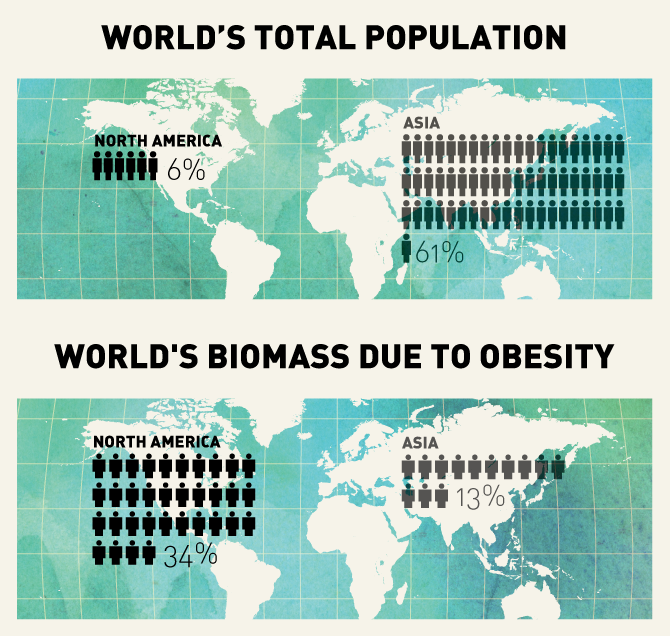
Some poor countries may have booming population growth, but oil rich countries could be exhausting the world’s resources just as fast with our waistlines. New research in the journal BMC Public Health argues that tackling population weight is crucial for food security and ecological sustainability.
Researchers from the London School of Hygiene & Tropical Medicine say that people’s weight – not just population size – should be taken into account when planning how to deal with increasing pressure on the planet’s dwindling resources. Presumably, this is because weight is a good indication of consumption, particularly of richer foods like meat and dairy that require more resources (like petroleum) to obtain.
Using data from the United Nations and World Health Organization, the researchers estimated the weight of the world’s entire adult population to be about 316 million tons. Of that total weight, they then estimated that 17 million tons of it is a result of people being overweight, and an additional 3.9 million tons is due to obesity.
While North Americans only account for 6% of the world’s population, we’re responsible for 34% of the world’s biomass due to obesity. By contrast, Asia has 61% of the world’s population but only 13% of the world’s biomass due to obesity. So what role does regional obesity play in environmental sustainability? One of the authors of the paper, Professor Ian Roberts, explained the thinking behind the calculation.
>”When people think about environmental sustainability, they immediately focus on population. Actually, when it comes down to it - it’s not how many mouths there are to feed, it’s how much flesh there is on the planet.”
>”If every country in the world had the same level of fatness that we see in the USA, in weight terms that would be like an extra billion people of world average body mass.”
Professor Roberts is careful to point out that focusing on obesity in individuals or in groups is divisive and unhelpful. “One of the problems with definitions of obesity is that it fosters a ‘them and us’ ideal. Actually, we’re all getting fatter,” he told BBC News.
While poor countries can obviously have leaner populations for all the wrong reasons, the researchers point to Japan as a good example of a prosperous country with a low obesity rate that could serve as a model for other countries.
One of the most fascinating aspects of the study is its coverage of how many oil rich nations have the heaviest populations. When you look at the list of countries with the largest proportion of overweight and obese citizens, it is clear that petroleum may play a role in obesity.
Heaviest 10 (for nations with more than 100,000 people):
Data and list obtained from the research here.
Prof Roberts says that the high number of Middle Eastern countries on the list is due to the impact of the automobile.
>”One of the most important determinants of average body mass index is motor vehicle gas consumption per capita. So, it is no surprise to see many of the Arab countries in the list - people eat but they move very little because they drive everywhere.”
Aside from all of the other profound drawbacks to oil dependence, obesity seems to have an exponential impact – both on our health and our use of dwindling resources. Obesity is a complex issue, caused by a number of factors, but what’s the connection to petroleum? Someone who consumes 4000 calories a day certainly has a larger carbon footprint than someone who consumes 2000 calories a day, particularly if the foods they are eating are shipped long distances, out of season, with an abundance of packaging. Having easy and affordable access to plentiful oil, as the citizens of most of the countries above do, makes it easier to have a larger carbon footprint. With oil, you can ship foods long distances, not do much “work” in the acquisition of food, and the infrastructure is there to drive everywhere you want. Have you ever driven cross-country in the US? It’s almost impossible not to end up going through a drive-though and eating in your car at some point in the voyage. At least here in the US, we have an infrastructure built around cars that lends itself to a continued dependence on oil.
But all is not lost. There’s never been a better time to get healthy and less oil dependent. Get out on your bike, start looking for a fuel efficient vehicle, and eat local! Your waistline, wallet, and the world will thank you.
The weight of nations: an estimation of adult human biomass [BMC Public Health]
Global Weight Gain More Damaging Than Rising Numbers [BBC]
Humans Are 17 Million Tons Overweight [Live Science]
Jun 20th, 2012 | By Nicole Rogers
Oil demand in the US will drop 0.4% to a 15-year low of 18.76 million barrels a day this year, according to a forecast released June 11 by the EIA (The US Department of Energy). Additionally, demand for gasoline, the most widely used petroleum product in the US, is expected to slip 0.6% from a year earlier, the lowest level since 2001. As the world’s biggest consumer of oil, this is a significant shift for the US, and a trend Sustainable America hopes to help continue.
“A part of it may be from slow economic growth, which is too bad, but much of it is from the US becoming less oil-intensive in its GDP creation and from a more fuel efficient fleet of vehicles.” Nick Tiller, founder of Sustainable America, wrote in an email.
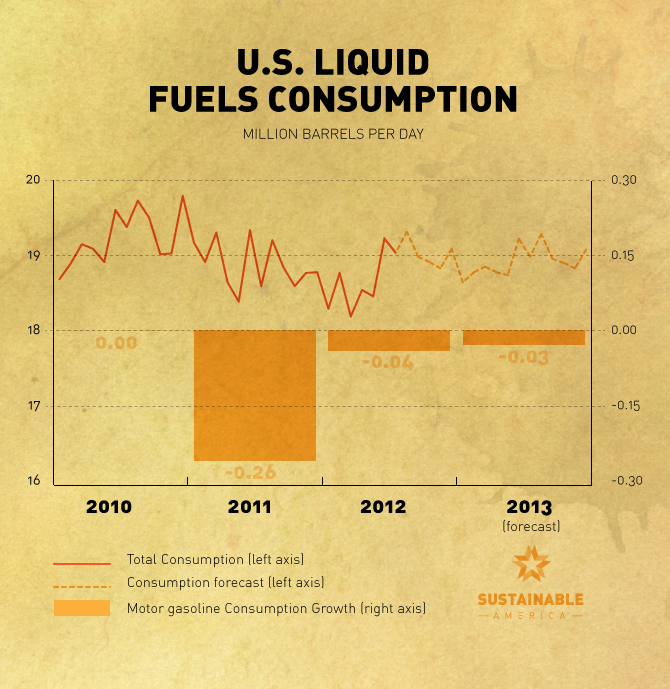
As you can see in the graph from the EIA above, the consumption of oil products fluctuates, but in general oil consumption has been trending downward recently, and will continue to according to projections by the EIA.
By making small changes everyday to minimize our personal consumption of oil we can all hope to sustain and encourage this trend in the future. See more posts in Sustainable America’s Good Practices / Individual Action category to learn how you can take action today!
Jun 19th, 2012 | By Nicole Rogers
Just 25 miles north of New York City lies an idyllic farm with a world class restaurant. The farm is The Stone Barns Center For Food and Agriculture, the restaurant, Blue Hill at Stone Barns. On this unique farm you might see farmers cooking and chefs farming. Bringing appreciation to the food we eat and how it is grown is central to The Stone Barn Center’s philosophy.
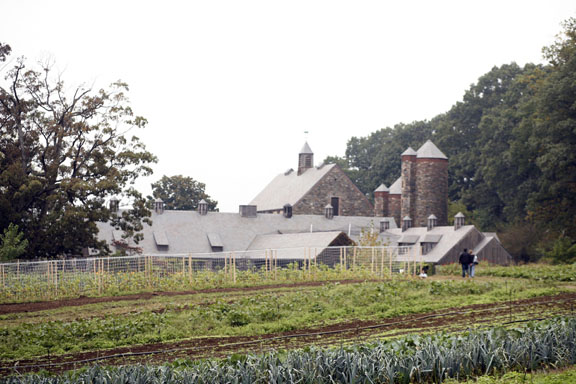
The center’s mission is to create a healthy and sustainable food system that benefits us all. With this goal in mind, the center has recognized the need for a new generation of farmers in the US, where the average age of farmers is 57.
One of the ways Stone Barns Center is working to help young farmers, and in turn stop the loss of farmers, farmland and rural economies, is through their Growing Farmers Initiative.
“Traditionally, farming knowledge was passed down from generation to generation. Today, many young people entering the field did not grow up on farms and are eager to learn directly from seasoned farmers. Stone Barns makes this possible for young farmers during every season of the year, offering paid, full-time apprenticeships to young people who are committed to working the land. Farm apprentices are given real responsibilities and gain practical knowledge on everything it takes to run a farm. Apprentices also benefit from networking opportunities with other farmers, apprentices and interns through weekly visits to other farms in the Hudson Valley.”
An exciting addition to the center’s Growing Farmers Initiative is their Young Farmers Conference. Young farmers (and by young they also mean new farmers of all ages) convene at the Stone Barns Center each December to attend workshops, exchange ideas, eat, and dance.
“Workshops are taught by seasoned farmers, and topics have included securing farmland, financing a farm, and launching a grass-based dairy farm. Recognizing that farming is by nature a solitary profession, our conferences and workshops provide invaluable opportunities for young farmers to share ideas and learn from each other.”
Stone Barns Center is planting the seeds for the future of farming. This year, more than 250 young farmers are expected to attend, and over 50 workshops that address soil science, technical skills, agricultural policy, farm business management, marketing, and more are planned.
The Young Farmers Conference runs from December 12 - 14, 2012.
The Stone Barns Center runs workshops year-round. See what workshops are coming up here.
Learn more about The Stone Barns Center For Food and Agriculture in this lovely video.
http://vimeo.com/15222791
[The Stone Barns Center For Food & Agriculture]
Jun 16th, 2012 | By Nicole Rogers
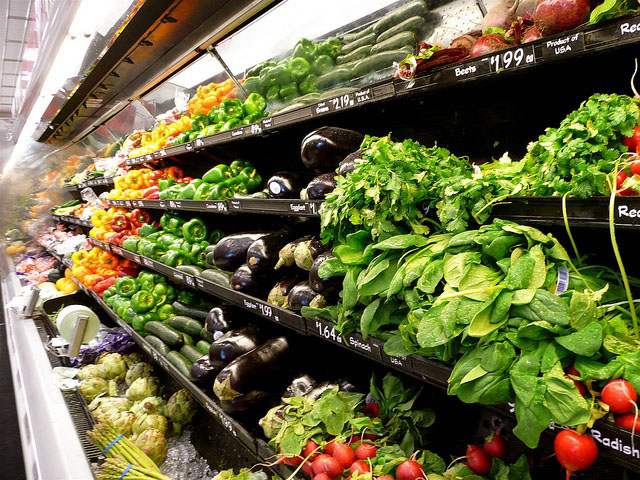 Photo by flickr user Scorpions and Centaurs / (CC BY-NC-SA 2.0)
## What are GMOs?
Plant and animal genetics have always been altered by humans through selective breeding of related organisms. But what we commonly call Genetically Modified Organisms, often referred to as transgenic, are organisms that contain genetic material into which DNA from an unrelated organism has been artificially introduced to create new traits, like resistance to drought, herbicides or pests. According to the New York Times, “For the most part, the spread of transgenic seeds into the American food supply has been purposeful, carried out by farmers and scientists who see enormous advantages in hardier plants.” [^1]
## Are they in the food I eat?
Chances are, yes. A February, 2012 New York Times article cited the Department of Agriculture as stating that last year “about 90 percent of all soybeans, corn, canola and sugar beets raised in the United States were grown from transgenic seed. Most processed foods (staples like breakfast cereal, granola bars, chicken nuggets and salad dressing) contain one or more transgenic ingredients, according to estimates from the Grocery Manufacturers Association, though the labels don’t reveal that. (Some, like tortilla chips, can contain dozens.)”
## What’s the controversy over labeling?
GMOs have passionate supporters and equally passionate detractors. While GMOs can make for hardier plants, better harvests, and arguably reduced pesticide use, consumers in the US tend to be resistant to the idea of eating foods made from GMOs, or at least eating them unknowingly.
> “In a 2010 nationwide telephone poll, 93 percent of those surveyed said that if a food has been genetically engineered or contains genetically engineered ingredients, it should say so on its label – a number that has been consistent since genetically modified crops were introduced. F.D.A. guidelines don’t require special labeling for GMOs in food, and products containing GMOs can still be labeled ‘all natural.’”[^3]
The labeling of GMOs is an ongoing debate in the US, but in Europe all genetically modified foods are required to be labeled. GMOs have encountered so much resistance in Europe that the German chemical group BASF said in January that it will transfer its main research into GM crops from Germany to the United States because of continued resistance to the crops in Europe.
## Why is this such a polarizing issue?
In a nutshell, opponents of GMOs in food argue that there has not been enough research done to assess risk, and that at a minimum GMOs in food should be labelled so the consumer can decide. Proponents of GMOs maintain that there is little difference between traditional plant breeding and transgenic breeding, that no toxicity has ever been proven, and no known health risks are associated with genetically modified foods. The Food and Drug Administration classifies transgenic foods as safe, though many scientists say it is too soon to assess the effects. [^2]
While there are legitimate concerns about GMOs such as pollen drift, fears that they will lead to a lack of genetic biodiversity, and theories that they could affect human health in unanticipated ways, in the most pragmatic sense GMOs with higher yields offer another tool to feed a booming world population at a time when the potential for land, oil and water crises is high.
An article in The Economist asserts that with India and China’s recent economic growth, “the world is likely to need much more food, at a time when arable land, water and energy become scarcer and more expensive. If they fulfill their promise, GMOs offer a way out of this bind, providing higher yields even as they require less water, energy and fertilizer.”
“In January, Bill Gates devoted most of his annual letter on agriculture from the Gates Foundation to the need for advanced technology. He later said that most people who object to transgenic agriculture live in rich nations, responsible for climate change that he believes has caused malnutrition for the poor,” writes Julia Moskin in the NYTimes piece.
It is difficult to wade through the information that both sides of this polarizing issue present, but the fact is you are probably already eating GMOs, and they are not currently specially labelled. The FDA has classified them as safe. Many of the answers both sides seek will best be answered in the future: What kinds of benefits can the next generation of transgenic organisms offer the world? Will they help eradicate hunger? What could the consequences be? In a world with more mouths to feed everyday, we may need GMOs more than we want them.
[^1]: New York Times: Modified Crops Tap a Wellspring of Protest
[^2]: Ibid.
[^3]: Ibid.
Jun 14th, 2012 | By Aubrey Yee
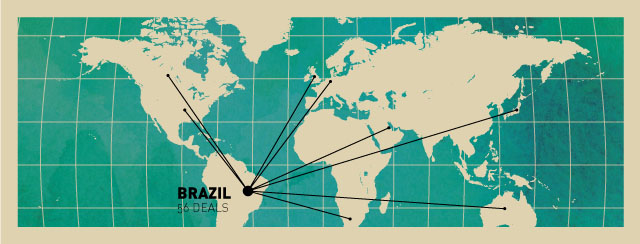


What would you do if you were the leader of a country with lots of people, little water and not enough good land for growing crops to feed your population? You might buy property in another country that can grow your food for you.
Welcome to what some are calling the “new colonialism”. It’s a great land grab sparked in part by the 2007-2008 food crisis that left some countries like China, India, South Korea and Saudi Arabia wondering how they might feed their growing populations in the future. The purchase of cheap agricultural land also promises great profit to the investors.
A think tank in California, the Oakland Institute, recently published a report titled New International Land Deals Database Reveals Rush to Buy Up Africa In the report, they explain that some 5% of Africa’s agricultural land has been bought or leased by investors since 2000. And since 2008, the pace of land deals has really ramped up without much international regulation.
In response to this alarming trend, a consortium of five major European research centers and 40 civil society/research groups has created the world’s largest public data base of international land deals. The portal was launched in April. Most of the deals have been shrouded in secrecy and a lack of available data has made it difficult to know how much land is really changing hands.
Their data has confirmed the suspicions that wealthy food-importing countries are buying up available agricultural lands in countries that already face food shortages. But increasingly, developing economies are getting in on the “new land rush”. In Brazil for example, agribusiness companies seem more inclined to invest in other South American countries while companies from South Africa tend towards investments in other less developed African nations.
But while nation-states may be leading the charge, invesment banks, hedge funds, commodity traders, pension funds, foundations and individuals are all getting involved in these land investments. Even some universities like Harvard and Vanderbilt are investing in foreign land for agriculture according to the Oakland Institute report.
The fallout of this shift in land remains to be seen, but with access to clean water a growing concern and food shortages like the famine in Somalia becoming more common, a clash between local farmers and foreign investors seems inevitable. Another report just published by the International Land Coalition and the Oakland Institute called Dealing with Disclosure aims to create greater transparency and regulation around these deals while giving local communities the tools they need to make fair and informed decisions when dealing with foreign investors.
Many of the investor countries see the purchase of viable agricultural land as crucial to their development of food security. Saudi Arabia, for example, has “earmarked $5 billion to provide loans at preferential rates to Saudi companies to invest in countries with strong agricultural potential,” according to the the U.K.-based Institute of Science in Society.
It seems that one country’s efforts to create food security may result in another country’s food shortage. To successfully feed the growing global population of 7 billion and counting, we are going to have to get creative and transparent, quickly.
Jun 14th, 2012 | By Nicole Rogers
There is collective sense of excitement at a an early morning farmers market. Nothing tastes better than the freshest possible ingredients, raised with care. But it’s not only about taste. The benefits of eating local are many - healthy fresh food, supporting the local economy, and reducing the nation’s dependence on oil for transport, to name a few. And if you ask the founders of Strolling of the Heifers, local food systems and the sense of community they create can be a whole lot of fun.
Strolling of the Heifers, an organization that works to promote sustainable local agriculture, is best known for their annual parade. Scores of pretty heifer calves wreathed in flowers, along with farmers, future farmers, floats, and various farm animals amble through Brattleboro, VT each year on the first weekend in June (National Dairy Month). It is an extremely popular event and captures the spirit of what the organization is all about. Strolling of the Heifers cherishes local farming, seeking to ensure that families hold onto their farms and produce more generations of local farmers to feed Vermont.
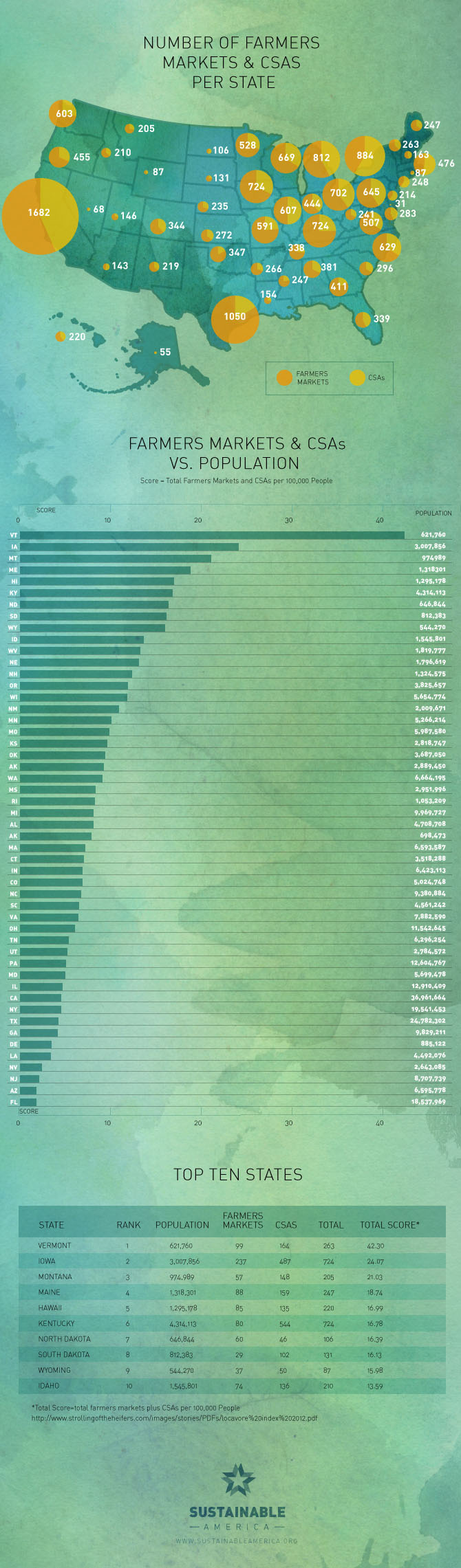
The state’s commitment to the locavore movement may be paying off statistically. Strolling of the Heifers created the Locavore Index (represented by our graphic above) this year, which indicates per-capita presence of local food sources by state in the form of CSAs (Community Supported Agriculture programs) and farmers markets. Vermont tops the list.
You might think that a state like California would have a huge number of farmers markets and CSAs, and you would be right, but California also has a huge population. As you can see in the map above, they are number one in sheer quantity of farmers markets and CSAs, but they rank 41st on the Locavore Index (indicated by the bar graph) because of access per capita. The states that top the Locavore Index have the best ratio of farmers markets and CSAs to population. Higher rank equals better access to local foods for the residents of that state.
Prime farmers market season is upon us! Don’t miss out on the freshest produce, dairy and meat your community has to offer. Use one of these databases to locate your nearest Farmers Markets and CSAs:
Jun 13th, 2012 | By Nicole Rogers
In a clever series of public service announcements by The Human Impacts Institute, NYC Climate Coalition and NYC Oil Addicts Anonymous, oil addiction is satirized in the context of a twelve step program like Alcoholics Anonymous. This video addresses food and oil addiction.
http://youtu.be/JSa4D1EEiMQ
Much of the food that we eat everyday travels thousands of miles before it gets to our table. See our posts on food miles here, and here.
By buying local foods, organic foods, and growing our own food, we can reduce the amount of oil it takes to produce what we eat. We can take action to reduce the carbon footprint of our food, while eating healthier and supporting local economies.
Take action today. Use one of these databases to locate your nearest Farmers Markets and CSAs:
Jun 10th, 2012 | By Aubrey Yee
Playing off the popularity of Al Gore’s “Inconvenient Truth” several concerned groups are now calling industrial agriculture the new ‘inconvenient truth’.
Wondering how we are going to continue to feed the 7+ billion people on this planet, a recent video by the University of Minnesota’s Institute of the Environment cites some alarming figures:
- More than 40% of the earth’s surface has been cleared for agriculture
- Global pastures cover 30 million km2–the size of the African continent
- Agriculture uses 60 times more land than urban and suburban areas combined
- Every year we use 2,800 cubic km of water on crops - its the biggest use of water on the planet, and major rivers and lakes are drying up
- Agriculture contributes more greenhouse gas emissions than all the planes, trains and automobiles on the planet combined.
http://youtu.be/hgmzV0E7ZoE
What are we to do? While there are no easy solutions, this video and others like it aim to elevate the global dialogue around this crucial issue quickly. The University of Minnesota group suggests initiatives around: incentives for farmers, precision agriculture, new crop varieties and drip irrigation. This is clearly a huge and complex issue, but one that will become increasingly present in international policy debates, and as a matter of survival, a reality we cannot ignore.
Jun 10th, 2012 | By Aubrey Yee
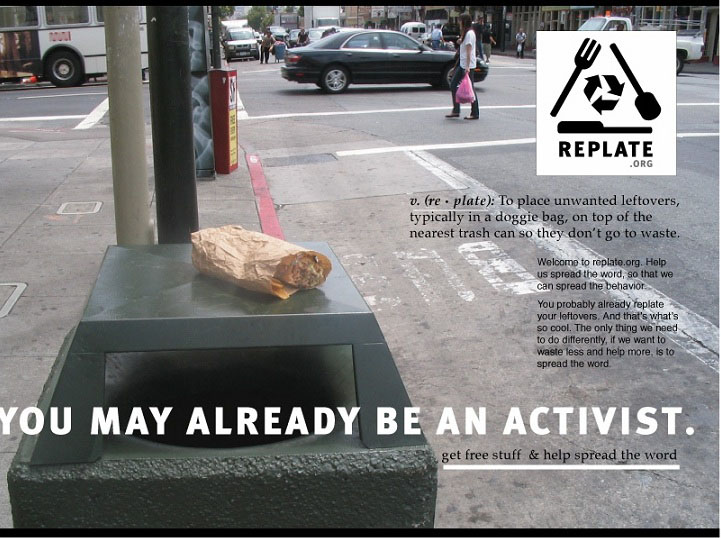
Replate - to place unwanted leftovers, typically in a doggie bag, on top of the nearest trash can so they don’t go to waste.
A simple concept, Replate was the brainchild of Language in Common founder Josh Kamler. The idea is designed to fight food waste by encouraging diners, particularly in urban environments, to take their leftovers to go even if they don’t intend to eat them.
Just leave the doggie bag with your extra food on top of a trash can. That way, the next homeless (or hungry!) person who comes along will be able to pick up the food and enjoy a good meal.
When you realize that some 40% of the food produced in America is not being consumed, it’s clear that we need to do all we can to curb food waste. So next time you’re out to eat, don’t leave the restaurant without your leftovers, Replate them!